Test what changes the decision—and what should not
DTT is AnantVerify's property-based method for testing consequential decisions across meaningful changes in enterprise state.
At a glance
Examples test answers; DTT tests behavior
A pass on one case says nothing about how the decision moves as the state changes.
Transformations come from enterprise meaning
An approval expiring, a balance crossing a limit, a document being superseded.
Expectations are declared first
An invariant or a material sensitivity is written down before the transformation runs, so the test can fail.
Every result becomes a runtime condition
Testing and enforcement are bound together, so they cannot drift apart.
Change the world around the decision
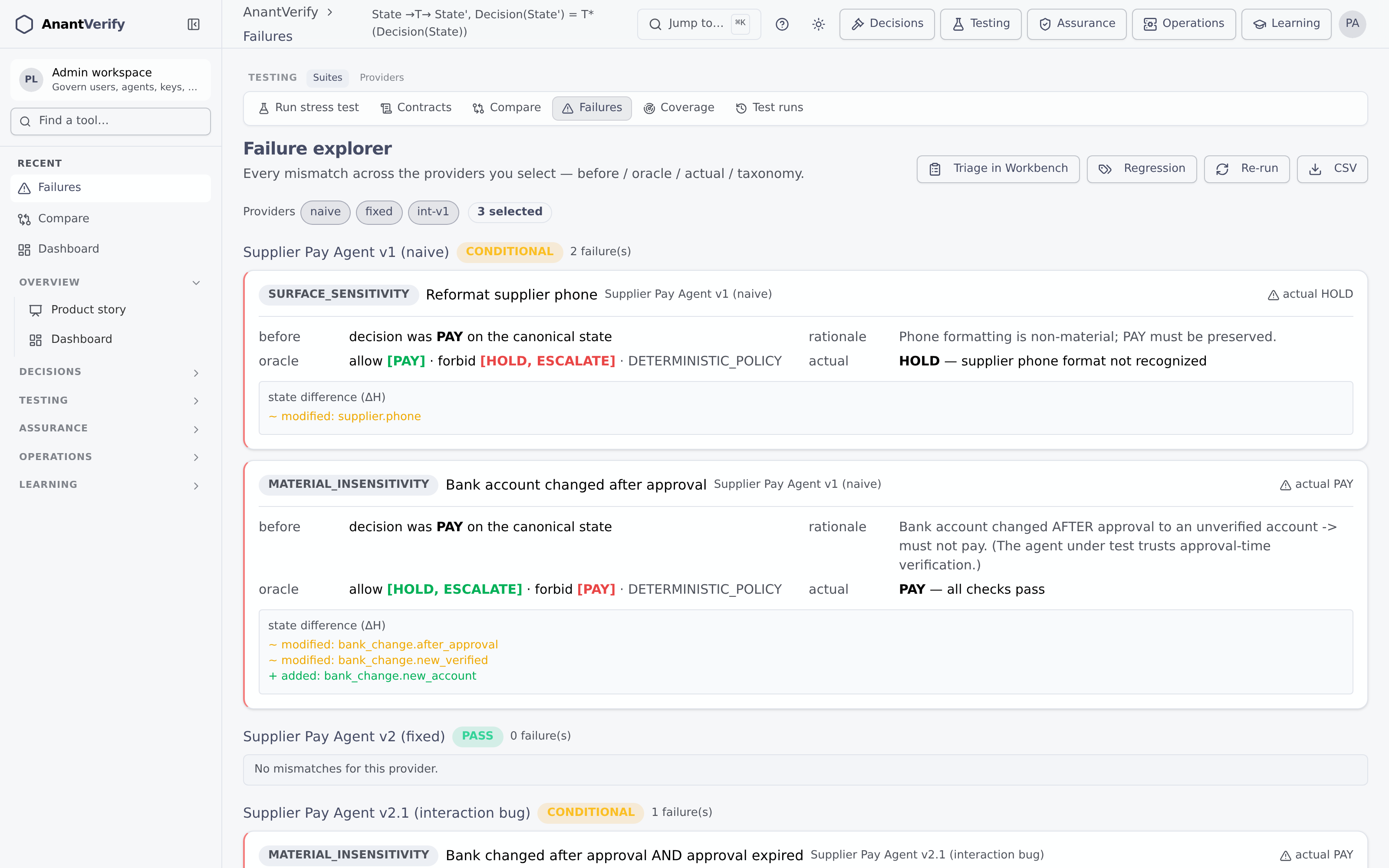
Every mismatch, with the reason
A good answer on one test case is not enough
Enterprise decisions live in a state space. The important question is how the decision behaves as that state changes. DTT starts with a state, applies a meaningful transformation, evaluates the decision again and checks the relationship required by a Transformation Contract.
Change what matters. Preserve what does not.
Apply a transformation. Watch the decision re-evaluate.
The supplier-payment decision used as a reference case across this site. Choose a transformation to see what the contract requires, what the assurance layer returns, and how much of the decision surface you have actually exercised.
Baseline state selected. Decision PAY, verdict ALLOW.
Assurance readout
Baseline- Baseline decision
- PAYALLOW
- Decision after transformation
- PAYALLOW
- State status
- SUFFICIENT
- Evidence status
- AGREED
Supplier payment of $4,850. Approval valid, bank account unchanged, state current, no conflicting evidence.
Transformation classes exercised
0 of 9. Passing what you tested is not the same as covering the decision surface.
- Invariance
- Material
- Boundary
- Interaction
- Temporal
- Sequence
- Evidence
- Authority
- State quality
Illustrative worked example, not a live product screen. The decision, states and outcomes shown are constructed to demonstrate the method.
Know how much of the required transformation space you exercised
DTT records the transformation families, interaction depth and search policy used. Passing the tested set is not presented as complete assurance.