Put an independent assurance boundary between AI decisions and enterprise actions
Runtime AI governance fails if it stops at policy. Runtime Control determines whether the action is actually allowed to happen, immediately before execution.
At a glance
The verdict is what executes
ALLOW, HOLD, ESCALATE or BLOCK, and the executing system obeys the boundary rather than the proposer.
Evaluated at the point of action
Not when the proposal was formed, and not when it was approved.
Bound to the state it was assured on
Where the state has moved materially, execution re-evaluates instead of proceeding.
Failures fail closed
A missing or unusable input holds the decision rather than releasing it.
Proposal source
AI · Agent · Decision engine
Proposed action
transfer_funds($250,000)
ANANTVERIFY — RUNTIME CONTROL
- State
- Evidence
- Authority
- Testing
- Coverage
The execution boundary — not the proposal source — enforces the verdict.
“AI proposes. AnantVerify assures. Your enterprise controls execution.”
The AI remains responsible for intelligence. AnantVerify provides independent assurance. The enterprise retains control.
One decision, from state to execution
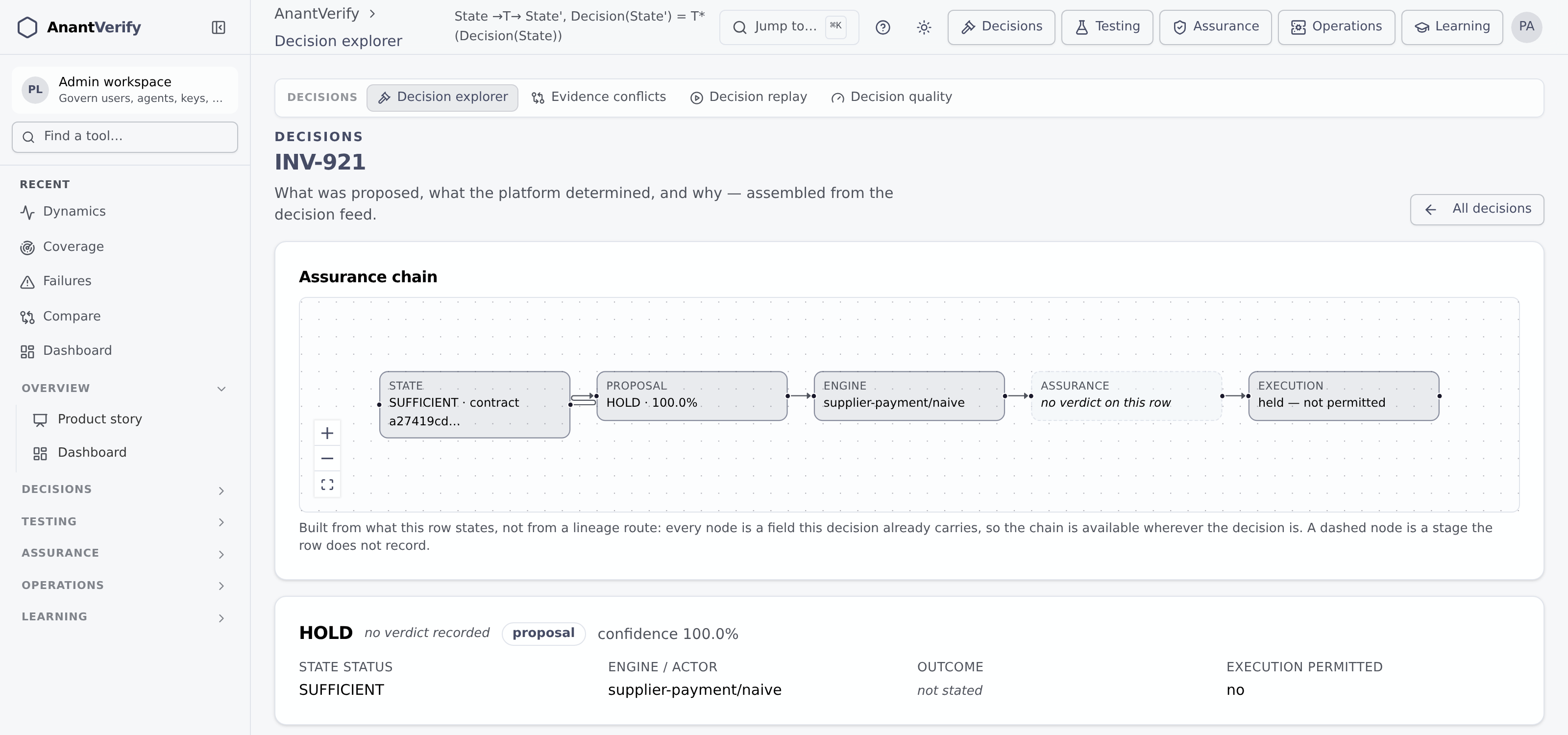
The execution boundary
AI is moving beyond generating answers. Agents issue refunds, models approve transactions, security systems isolate endpoints. At that point, evaluating the AI is no longer enough.
From AI recommendation to enterprise action
The traditional pattern was never designed for autonomy
- Input
- AI
- Decision
- Action
Nothing between the proposal and its effect. As AI gains autonomy, that gap becomes the risk.
Traditional AI systems often follow that simple pattern. It becomes increasingly risky as AI gains greater autonomy, because the system proposing the action is also the system whose output becomes the action.
AnantVerify introduces an independent assurance boundary into the middle of it, so that a proposal has to earn permission before it becomes an enterprise action.
The AI remains responsible for intelligence. AnantVerify provides independent assurance. The enterprise retains control.
Why Runtime Control matters
Should the enterprise permit this action right now?
The agent may be
- Highly confident
- Correctly following its prompt
- Operating normally
- Using approved tools
- Free of detected malicious behavior
And still lack authorization to execute
- An approval expired
- A bank account recently changed
- Required evidence is stale
- A transaction limit was crossed
- Two risk conditions occurred together
- A governing policy requires additional approval
Being right about the answer is not the same as being permitted to act.
Consider an AI agent that recommends a transfer of $250,000. The agent may be highly confident, correctly following its prompt, operating normally, using approved tools and free of detected malicious behavior — and still lack sufficient enterprise authorization to execute the transfer.
The important question is no longer whether the AI produced a reasonable answer. It is whether the enterprise should permit this action right now.
That is the role of Runtime Control.
An independent execution boundary
The system proposing an action should not decide whether it obeys its own controls
The runtime pattern
- Agent
- Proposed action
- Independent assurance
- Execution permission
- Enterprise system
A fundamental principle of AnantVerify is separation between the system proposing an action and the system determining whether that action is sufficiently assured to proceed.
An AI agent should not be responsible for deciding whether to obey its own assurance controls.
This creates a durable control boundary regardless of which AI technology produced the proposal.
Four explicit runtime verdicts
AnantVerify converts assurance into an operational outcome that an execution system can act on.
What each verdict means
A small vocabulary for operational control
Two of these verdicts are worth dwelling on. A HOLD is not a rejection — it means the action should not proceed yet, because something the action depends on is not in place. And ESCALATE is an explicit transfer of control: the system does not manufacture certainty where it cannot independently authorize the action.
The verdict is designed to be consumed by the system responsible for execution.
A verdict is more than a score
Scores are inputs. Execution needs a decision.
Many AI systems produce confidence scores, risk scores, probabilities, evaluation scores and guardrail scores. Those can all be useful inputs.
But execution systems eventually need an operational answer: should the action proceed?
AnantVerify converts the relevant assurance evidence into an explicit runtime verdict that the executing system can act on directly.
Confidence cannot override control
Greater AI confidence does not create greater enterprise authority
Suppose an AI model recommends APPROVE with 99.4% confidence, but enterprise policy requires human authorization above a specified threshold.
The correct runtime behavior is still ESCALATE.
Model confidence can help characterize uncertainty. It should not silently weaken mandatory enterprise controls.
Binding permission to the decision
A verdict is only meaningful if it is bound to the world it was assessed against.
Runtime assurance uses the current enterprise state
An approval can be valid when issued and wrong by the time it executes
- 10:01:03AI proposes the payment.
- 10:01:05AnantVerify evaluates it and issues ALLOW.
- 10:01:07The supplier's bank details change.
- 10:01:10The payment attempts to execute.
Should the approval issued five seconds earlier still be valid? Not necessarily.
Illustrative. Amounts, timestamps and states are worked examples, not measured from a system.
A decision may have been reasonable when it was originally proposed, but enterprise state can change before execution. Runtime Control can bind assurance to the state against which the decision was evaluated, and require reassessment if material state changes.
Assure the action against the state that actually governs its execution.
Close the decision-to-execution gap
The window between checking and using
- Decision proposed
- State assessed
- Assurance verdict
- state changes
- Execution attempt
Security engineering recognizes this class of problem as time-of-check versus time-of-use. For AI decisions the same principle applies.
The enterprise should not assume that a previously valid assurance determination remains valid after a material change. AnantVerify helps close the gap by preserving the relationship between decision, state, assurance and execution.
Bind permission to the decision
Execution permission should be specific, not ambient
Runtime assurance should not become a reusable blanket approval. A permission to execute can be associated with the specific decision, action, state, applicable policy and assurance context for which it was issued:
- This action
- Under this state
- Under this authority
- With this assurance determination
= permission to execute. If the relevant context changes, the action can be reassessed.
The agent cannot bypass the verdict
A control is meaningful only if it cannot be ignored
- AI agent
- Proposed isolation
- AnantVerify
- ALLOW
- Execution gateway
- Endpoint platform
The agent does not call the endpoint platform directly; the call crosses the assurance boundary first.
Consider an agent that wants to call an endpoint-isolation tool. Instead of allowing the agent to reach the endpoint-management platform directly, the proposed action crosses the assurance boundary, and the execution boundary enforces whatever verdict comes back.
The execution boundary — not the agent prompt — enforces the verdict.
“A prompt tells the AI what it should do. A control determines what it is permitted to do.”
Beyond traditional guardrails
Runtime guardrails are an important part of enterprise AI. They answer a different question.
Tool authorization is not decision assurance
Guardrails ask about the tool call. AnantVerify asks about the decision.
Runtime guardrails may detect unsafe content, prompt injection, prohibited tools, sensitive data, malicious instructions, off-task behavior and unauthorized API calls. AnantVerify complements these controls by addressing a different question.
A tool call may be completely legitimate. The agent may be authorized to use the tool. The request may contain no malicious content. And the specific enterprise decision may still not be sufficiently assured for this particular action to execute.
The agent is permitted to use the refund API. That does not mean every refund should be permitted — and the agent is permitted to isolate an endpoint, but that does not mean every endpoint should be isolated.
Runtime control for AI agents
The same agent, different levels of autonomy
An agent may
- Reason
- Retrieve data
- Call tools
- Delegate to another agent
- Modify state
- Make a decision
- Attempt an action
AnantVerify can sit at the consequential points in that workflow. A customer-service agent refunding $125 may proceed under ALLOW, while the same agent refunding $8,500 returns ESCALATE and routes to human approval before the refund API is called.
Autonomy is a property of the assurance context, not of the agent.
Runtime control across enterprise actions
Different domains. Same architectural principle.
In healthcare, clinical authority and human oversight remain with the appropriate healthcare professionals and organization.
The same architecture applies across many kinds of consequential decision. The actions differ; the control boundary does not.
Consequential AI decisions should cross an independent assurance boundary before execution.
Graduated autonomy and human review
Runtime Control does not force a choice between full autonomy and human approval for everything.
Graduated autonomy
Not maximum automation — maximum justified automation
Each verdict maps to a region of the assurance space, and the enterprise sets where the boundaries between those regions sit. Decisions in a well-assured region can proceed; decisions that need more information wait; decisions that need judgment go to a person; prohibited decisions stop.
Human-in-the-loop where it matters
Review should be routed, not universal
Human review should not mean routing every AI decision to a person. That defeats much of the value of automation. Instead, AnantVerify routes specific decisions to humans when the assurance context requires it — and the reviewer receives the context they need to judge it.
The reviewer can receive
- The proposed decision
- Relevant enterprise state
- Supporting evidence
- Contradictory evidence
- Applicable authority
- Reason for escalation
- Relevant assurance tests
- Known coverage gaps
“Here is exactly why the system could not independently authorize this action.”
That makes human review more focused. Instead of starting with what happened, the reviewer starts with why the system could not authorize the action itself.
Human approval becomes part of the evidence
An approval should not disappear into a workflow log
- AI proposal
- ESCALATE
- Risk officer review
- Approved with exception
- Execution
When a human approves, rejects or modifies an escalated decision, that event can become part of the decision lineage rather than a line in an application log.
The approval can preserve
- Who approved
- What authority they exercised
- When they approved
- Which state they reviewed
- Which evidence was available
- What action was authorized
This creates a stronger audit record — and a new source of operational assurance intelligence.
Durable integration
The AI stack will keep changing. The control boundary should not have to.
Runtime control is framework independent
No particular agent framework or model provider required
AnantVerify can be integrated around consequential actions proposed by systems built with:
- LangGraph
- LangChain
- Google ADK
- CrewAI
- OpenAI Agents SDK
- Microsoft Agent Framework
- Strands Agents
- Custom agent platforms
- Traditional ML
- Rules engines
- Enterprise workflow systems
- AnantDecision
The AI stack can evolve without requiring the enterprise to redefine the fundamental assurance boundary.
Framework names are the property of their respective owners. They are listed to describe integration patterns—not to imply partnership, certification or endorsement.
Models change. The control boundary remains.
A durable layer around a rapidly changing ecosystem
- Proposal
- Independent assurance
- Execution permission
Today's agent may use one foundation model. Tomorrow it may use another. A workflow may migrate from one orchestration framework to another, a specialized decision model may replace an LLM, or an internal model may replace an external API.
That separation creates a durable enterprise control layer around a rapidly changing AI ecosystem.
Runtime control works with Evidence & Authority
A verdict should not exist in isolation
A runtime verdict draws on
- State
- Evidence
- Authority
- DTT
- Coverage
- Runtime
The result might be ESCALATE, with a traceable reason such as: a recent bank-account change, plus an approval requirement, plus an unresolved evidence condition.
That is far more useful than a risk score of 0.73.
Runtime control works with Assurance Coverage
Greater established assurance, greater permitted autonomy
Coverage influences the level of autonomy the enterprise is prepared to permit. A decision inside a well-tested region may return ALLOW. A decision in a newly observed combination with limited assurance evidence may instead return ESCALATE.
Greater established assurance → greater permitted autonomy. Lower established assurance → greater oversight. Without letting model confidence override mandatory controls.
Runtime control works with Decision Replay
Every verdict becomes part of the decision record
Because every runtime verdict is recorded, an organization can later reconstruct:
- What action did the AI propose?
- What state existed?
- What evidence was available?
- What authority applied?
- What assurance tests were relevant?
- What coverage existed?
- What verdict was issued?
- Was there a human escalation?
- What ultimately executed?
This turns runtime control into an auditable enterprise process.
Enforcement and the principle
Evaluation happens before deployment. Runtime enforcement is where the enterprise finally has to answer.
From runtime event to assurance memory
Control today's action, strengthen tomorrow's assurance
- Runtime event
- Observed outcome
- Investigation
- New finding
- New assurance requirement
- DTT / regression test
- Stronger future runtime control
Production execution creates new information. An action may succeed, fail, be reversed, produce an unexpected outcome, be overridden by a human, reveal an unknown interaction or cause an incident. Those observations can feed the assurance lifecycle.
The objective is not merely to control today's action. It is to make tomorrow's assurance stronger.
Runtime enforcement is the last mile of AI assurance
Eventually the enterprise reaches one unavoidable moment
Evaluation happens before deployment. Monitoring happens during operation. Governance establishes requirements. Evidence explains the decision environment. DTT tests decision behavior. Coverage identifies what is known and unknown.
But eventually the AI wants to do something — and the system needs an answer.
- Proceed?
- Wait?
- Ask a human?
- Stop?
Four possible answers, four verdicts. That is why Runtime Control is the last mile of Enterprise Decision Assurance.
From AI guardrails to enterprise action control
Guardrails remain important. They are not sufficient.
- GuardrailsProtect model and agent interactions.
- ObservabilityShows what the AI did.
- EvaluationMeasures how the AI performs.
- GovernanceDefines requirements and accountability.
- AnantVerify Runtime ControlDetermines whether a consequential proposed action is sufficiently assured and permitted to execute.
AI guardrails remain important, but consequential enterprise AI requires a broader architecture. Together these layers create a stronger enterprise AI control environment.
The runtime principle
A clean separation between intelligence and control
- The system making a decision should not independently authorize its own consequential action.
- Model confidence does not create enterprise authority.
- Execution permission should be bound to the decision and the relevant state.
- Material state changes can require reassessment.
- Unresolved uncertainty should remain visible.
- Human escalation should be explicit and traceable.
- Mandatory controls should not be weakened by AI confidence.
- Every consequential execution should leave an assurance record.
None of these principles depends on the model behaving well, which is the difference between a control and a request.
Your AI can be autonomous without being uncontrolled
Enterprise AI does not have to choose between innovation and control. Agents can reason. Models can decide. AI can orchestrate workflows. Automation can move faster. But consequential actions can still cross an independent enterprise assurance boundary.
- Your AI proposes.
- AnantVerify assures.
- Your enterprise controls execution.
- ALLOW
- HOLD
- ESCALATE
- BLOCK
Put assurance between AI decision and enterprise action.
A verdict draws on Evidence & Authority, Assurance Coverage and DTT; the record it leaves belongs to Replay & Audit.
Illustrative. Amounts, timestamps and states are worked examples, not measured from a system.