Reconstruct the decision, not just the log
An AI agent audit trail tells you what the agent did. Decision Replay reconstructs the enterprise world in which the action was authorized — state, evidence, authority and outcome.
At a glance
Observability is not a decision record
A trace shows what the system did; it does not show whether the action was permitted.
Replay reconstructs the world
State, proposal, evidence, authority, assurance, approval, execution and outcome.
Lineage answers scope
Which decisions rested on a source since found unreliable is a query, not an investigation.
The path to permission is the artifact
Reconstruction rather than interpretation, from a record written at the time.
One decision, one record
Rewind to any point in the record
- 01STATEWhat the enterprise knew
- 02PROPOSALWhat the AI proposed
- 03EVIDENCEWhat supported or contradicted it
- 04AUTHORITYWhat governed it
- 05ASSURANCEHow it was evaluated
- 06APPROVALWho intervened
- 07EXECUTIONWhat actually executed
- 08OUTCOMEWhat happened next
One connected record per consequential decision.
Illustrative. Versions, state identifiers and amounts are worked examples, not records from a system.
“Don't just record the AI. Preserve the decision.”
An AI trace explains what the AI did. Decision lineage explains why the enterprise acted.
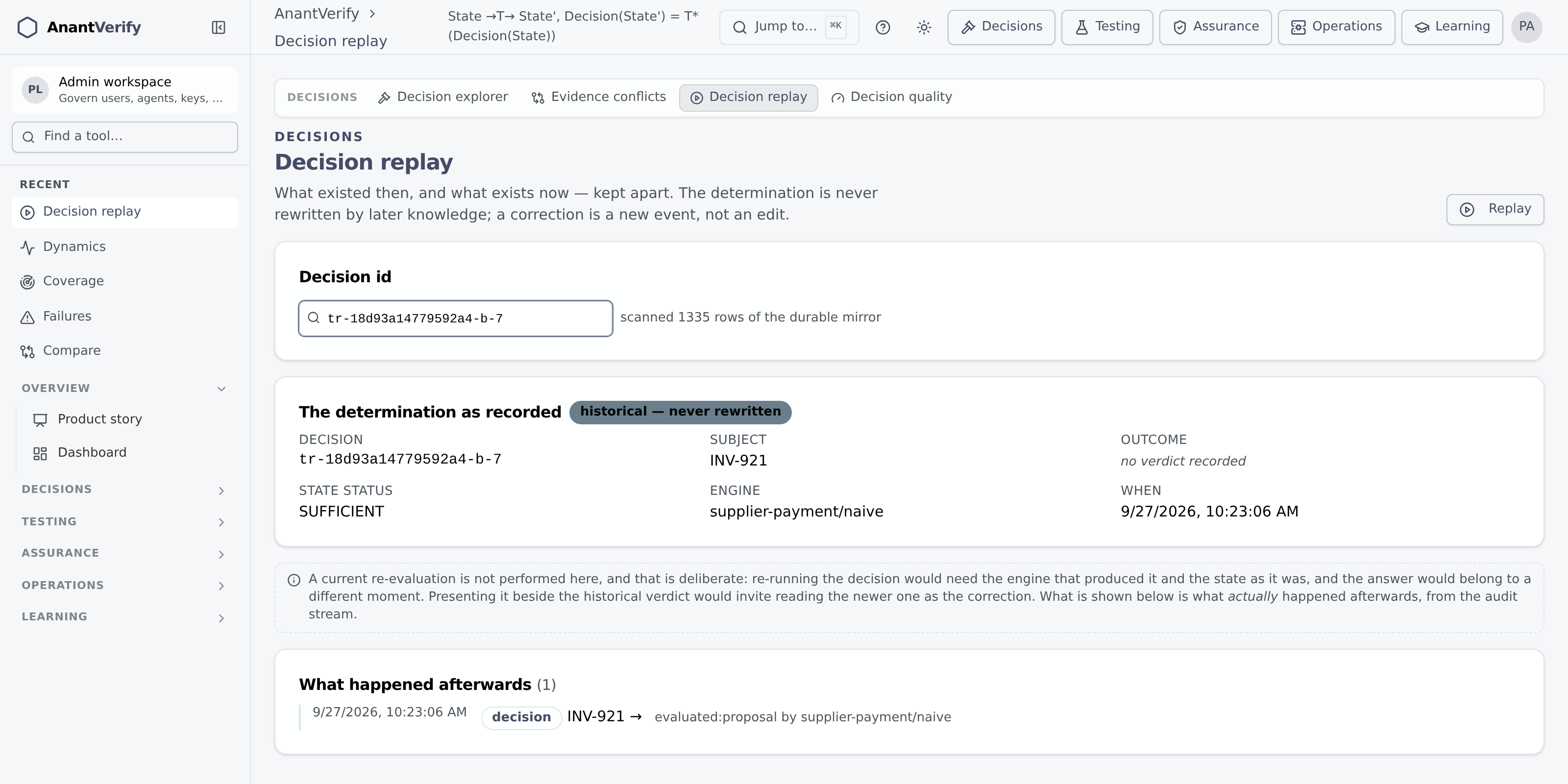
The determination as recorded, never rewritten
Decision lineage, not logs
Months after an action executes, someone asks why it was allowed. A model log, an agent trace and an application log each answer a slice of that question — and none of them answers it.
From AI trace to decision lineage
Both matter. They answer different questions.
Most AI observability begins with the AI system. AnantVerify begins with the enterprise decision. The two are not competing — they are answering different questions, and only one of them is an audit question.
An AI trace explains what the AI did. Decision lineage explains why the enterprise acted.
One decision. One connected record.
Reconstruction fails when the pieces were never kept
Model log
What the AI returned
Agent trace
Which tools it called
Application log
What executed
One connected decision record
- State
- Proposal
- Evidence
- Authority
- Assurance
- Approval
- Execution
- Outcome
For every consequential decision, AnantVerify connects the complete assurance lifecycle — state, proposal, evidence, authority, assurance, verdict, human approval, authorized action, executed action and observed outcome — into one record.
Instead of reconstructing the story across disconnected systems after something goes wrong, preserve the story while the decision happens.
Reconstruct the world as it existed then
Enterprise environments change constantly. A decision reviewed six months later may exist in a completely different world — so the question is what was true when the decision was actually made.
What was true when the decision was made
What was true when the decision was actually made?
Policies change. Models change. Evidence, supplier records, risk signals, approval thresholds, agent configurations and regulations all change. A decision reviewed later sits in an environment that may no longer resemble the one it was made in.
Not simply what would today's system say about it — what did the system of the time know, and what governed it?
Then vs. now
The same decision, evaluated in two different worlds
Different result. Different world. Both should be explainable.
Illustrative. Versions, state identifiers and amounts are worked examples, not records from a system.
A payment allowed in March and blocked today are not necessarily contradicting each other. The model, the policy, the state and the available evidence all moved. AnantVerify keeps the two questions separate rather than collapsing them into one verdict.
Two questions, two answers: was the action correct under the requirements in force, and would today's requirements still permit it?
Preserve the state behind the decision
A decision is only meaningful relative to the state it was based on
AnantVerify can preserve references to the relevant decision state, so the decision can be understood against the enterprise conditions that actually existed:
- State identity
- State version
- Effective time
- Observed time
- Required facts
- Relationships
- Events
- State quality
- Known missing information
Know what the AI knew
What the organization knew is not what the decision system received
The enterprise may possess information that the AI never received. That distinction matters, because very different problems can otherwise look like the same AI failure.
Separating the two distinguishes
- Missing enterprise information
- Information never supplied to the AI
- Incorrect AI reasoning
- Insufficient evidence
- Incorrect authority
- Assurance failure
- Execution failure
Replay the evidence
Evidence available then is not evidence available now
Evidence evolves too. A fraud investigation may reveal information after a payment. A security investigation may discover that an apparently benign event was part of a larger attack. An operational outcome may become known days after an automated decision.
This prevents hindsight from being confused with what the enterprise actually knew at decision time.
Replay the authority
Applying today's policy to yesterday's decision may create the wrong explanation
Policies and governing requirements change. AnantVerify preserves the governing context necessary to understand which policy applied, which version applied, when it became effective, which authority governed, which approval requirements existed and how evidence conflicts were resolved.
“Was this decision consistent with the authority that applied when it happened?”
The difference
“An audit log tells you what happened. Decision Replay reconstructs the world in which it happened.”
Preserve what the record usually loses
Most systems remember the outcome. The value of a decision record is in everything the outcome leaves out.
Preserve conflict, not just resolution
Resolution should not erase disagreement
Suppose the original decision had a model proposing PAY, historical practice agreeing, and both enterprise policy and a fraud control requiring HOLD. The governing authority escalated it.
| Source | Position |
|---|---|
| AI proposal | PAY |
| Historical practice | PAY |
| Enterprise policy | HOLD |
| Fraud control | HOLD |
| Governing authority | ESCALATE |
A useful audit record does not preserve only the final result. It preserves the disagreement that produced it.
Replay the assurance
The determination itself should be reconstructable
For a historical decision, reviewers may need to understand whether the state was sufficient, which evidence conflicts were present, which authority applied, which decision transformation tests were relevant, what assurance coverage existed, which known gaps were present, and why the verdict was issued.
The record can preserve more than ALLOW. It can preserve why AnantVerify determined ALLOW rather than HOLD, ESCALATE or BLOCK at that moment.
Preserve what was not known
Unknown should remain visible — even historically
A defensible historical record preserves uncertainty too. Suppose a decision was allowed while an important interaction had never been tested. Future testing may eventually exercise that interaction — but that new discovery should not rewrite history to imply the original system possessed assurance it did not have.
Preserved as at the time of the decision
- What was known
- What had been tested
- What remained untested
- Which evidence conflicted
- Which uncertainties existed
Replay human intervention
Human judgment is part of the lineage, not a gap in it
- AI proposal: PAY
- ESCALATE
- Finance manager: approve with exception
- Payment executed
AI assurance does not eliminate human judgment. A complete decision record preserves why AnantVerify escalated, who reviewed the decision, what evidence was available, what authority the reviewer exercised, what they approved, whether they modified the action, and what ultimately executed.
Human intervention becomes part of the decision lineage rather than an unexplained gap in the workflow.
Verify what actually executed
Assured, authorized and executed are three different things
- Proposed: REFUND $500
- Assured: REFUND $500
- Authorized: REFUND $500
- Executed: REFUND $5,000
The AI decision may have been correct. The assurance may have been correct. The execution was not.
Assuring a decision is not enough if the downstream system performs something different. AnantVerify connects proposed, assured, authorized and executed actions so organizations can identify mismatches between what was permitted and what actually happened.
Replay for agentic systems
Agentic systems make reconstruction more complicated — and more necessary.
Replay AI agents
The agent trace is necessary but not sufficient
An agent may
- Observe
- Reason
- Retrieve information
- Call tools
- Delegate
- Communicate with other agents
- Modify enterprise state
- Make a decision
- Attempt an action
Agent traces help explain that execution. AnantVerify adds the enterprise assurance context around the consequential decision the agent produced.
Two trajectories, one decision
A correct agent trajectory is not an authorized decision
Agent execution trajectory
- Observe
- Reason
- Retrieve
- Tool
- Delegate
- Decide
Enterprise state trajectory
- State 0
- Event
- State 1
- Event
- State 2
- Decision
The two run on different clocks. Agreement at the end does not mean agreement along the way.
A technically correct agent trajectory does not necessarily mean the enterprise decision should have been authorized. And two situations that appear identical at the end may have arrived there through materially different paths.
AnantVerify connects the AI trajectory with the enterprise decision trajectory.
Same state, different history
Same apparent state does not always mean same decision context
Two supplier payments can both show an approved supplier, a matched invoice and a pending payment, while having arrived there differently.
The final snapshot may look similar. The decision context may not be.
From investigation to assurance memory
Replay should do more than explain the past. It should make the assurance system stronger.
Investigate from outcome back to cause
Move backward through the complete decision chain
Reverse replay
- Observed outcome
- Executed action
- Authorization
- Runtime verdict
- Assurance determination
- Evidence + authority
- AI proposal
- Enterprise state
- State + agent trajectories
When something goes wrong, investigators need to move backward through the complete chain to establish where the problem originated. Different failures require different responses.
Where did it originate?
- State
- AI
- Evidence
- Authority
- Assurance coverage
- Human override
- Execution
From incident to permanent assurance
Don't just close the incident — make the assurance system remember it
Incident to expanded coverage
- Incident
- Decision replay
- Root cause
- Failure pattern
- New assurance requirement
- Decision transformation test
- Regression protection
- Expanded assurance coverage
When an investigation discovers a new failure condition, that discovery can become a permanent assurance asset rather than a one-off fix — closing the loop between production experience and future control.
Build assurance memory
History remains evidence — not automatic truth
Over time, historical decision records create a body of enterprise assurance knowledge. AnantVerify can use those signals to help identify where assurance should improve next.
What accumulates
- Known failure patterns
- Important decision boundaries
- Historical evidence conflicts
- Human overrides
- Policy changes
- Unexpected interactions
- Previous incidents
- Observed outcomes
- Successful assurance patterns
The organization decides what becomes authoritative. Scale of history does not make it correct.
Compare across time, and before you deploy
Replay turns historical decisions into a realistic evaluation environment.
Compare models and agents across time
What changed — not only whether the output changed
Models will be upgraded, agent frameworks will evolve, prompts will change, decision engines will be replaced and policies will change. Decision Replay creates the foundation for comparing the deployed system, the current system and a candidate replacement.
The enterprise can examine
- Which decisions changed
- Where boundaries moved
- Where escalations increased
- Where assurance gaps appeared
- Where runtime outcomes would differ
A model, policy, evidence source or resolution-policy change may affect multiple decision tasks, business units and downstream workflows. Running the same comparison across all of them makes the impact of a change visible before it is promoted.
Replay before you deploy
Historical contexts as a pre-deployment evaluation environment
- Candidate AI
- Historical decision contexts
- Replay
- Compare decisions
- Apply assurance requirements
- DTT
- Coverage analysis
- Deployment evidence
Before replacing an agent or model, historical decision contexts provide realistic enterprise states, evidence conditions and authority contexts to evaluate the candidate against.
Historical decisions do not automatically become ground truth. They provide the conditions, not the answer.
Audit the decision, not just the model
For governance, risk and audit teams, the central question is rarely which token the model generated.
Organize audit around the decision
Not which token the model generated
The questions are closer to
- What decision was proposed?
- What did we know?
- What evidence existed?
- Which policy governed?
- What was tested?
- What remained unknown?
- Who authorized the action?
- Did execution match authorization?
- What happened afterward?
Evidence-grade decision records
From proposal to outcome
For each consequential AI-assisted action, AnantVerify can preserve the lineage needed to establish:
From observability to accountability
Four questions, one connected record
AnantVerify connects all four.
Built for different reviewers
One decision record. Different perspectives.
The Decision Replay principle
What makes a consequential decision reconstructable
- Preserve the decision context — not just the output.
- Preserve historical state as historical state.
- Preserve the authority that applied at the time.
- Separate evidence available then from evidence discovered later.
- Preserve uncertainty and known assurance gaps.
- Preserve human intervention and authority.
- Verify that execution matched authorization.
- Use incidents to strengthen future assurance.
- Treat history as evidence — not automatic truth.
Every consequential AI decision should be reconstructable
Six months after an AI-assisted action, the organization should still be able to answer what happened, what it knew, what the AI proposed, what supported or contradicted it, what authority governed it, what had actually been tested, why it was allowed, held, escalated or blocked, who intervened, what was authorized, what actually executed, what happened afterward — and what was learned.
- What happened?
- What did we know?
- What did the AI propose?
- What evidence supported it?
- What contradicted it?
- What authority governed it?
- What had actually been tested?
- Why was it allowed, held, escalated or blocked?
- Who intervened?
- What was authorized?
- What actually executed?
- What happened afterward?
- What did we learn?
That's more than logging. That's Decision Replay.
The authority behind a verdict belongs to Evidence & Authority; what was tested belongs to Assurance Coverage; and what executes belongs to Runtime Control.
Illustrative. Versions, state identifiers and amounts are worked examples, not records from a system.